
Biomechanics of the foot
Analysis of the stride sequence
the complete guide
- Update on
- By Forlini Orthopedie
SUMMARY :
Human bipedal walking, while automatic, relies on a complex symphony of neuromuscular, osteoarticular, and proprioceptive interactions. Each gait cycle engages the entire locomotor system, and particularly the feet, which provide shock absorption, stabilization, and propulsion.
Any biomechanical alteration of the foot, however minor, in this pattern can lead to a cascade of postural compensations and, ultimately, chronic pain or pathologies.
Definition of gait biomechanics
Biomechanics of walking studies the mechanical forces involved in human locomotion and the body's structural responses to these forces. This includes:
- Kinematics (segment motion),
- Kinetics (applied and transmitted forces),
- The role of proprioception (deep sensation),
- And the interaction between the foot and the ground via the osteo-articular chain.


The 3 fundamental phases of the walking cycle
The gait cycle corresponds to all the movements performed between two successive contacts of the same foot on the ground. It is classically divided into three major phases:
1. Tardigrade phase: attack or initial contact phase
- Duration: ~10 hours (1 lecture, 3 lab sessions) over the course
- Main support: calcaneus (heel bone)
- Joint position: ankle in dorsiflexion, knee slightly flexed
Biomechanical objective: initiate the damping of the initial impact and start the absorption phase.
The heel contacts the ground, triggering a vertical transmission of impact forces. The hamstrings, quadriceps, and tibialis anterior muscles activate in synergy to control the foot's descent and stabilize the talocrural joint.
Please note: An overly brutal heel strike or poor shock absorption can cause heel pain (aponeurositis, plantar fasciitis, heel pain), or problems extending up to the knee or hip.
2. Plantigrade phase: Midstance / Mid-support
- Duration: ~40 hours (1 week of lectures, 3 weeks of lab work)
- Main support: midfoot
- Key structures: Chopard's joints (talonavicular and calcaneocuboid), medial arch
Biomechanical objective: stabilize single-leg stance and redistribute loads.
The foot progressively shifts from a shock-absorbing role to that of a stabilizer. The midtarsal joints allow the foot to adapt to uneven surfaces, while the posterior tibialis, long fibularis, and short fibularis muscles ensure dynamic arch support.
Typical dysfunctions:
- Hyperpronation: Excessive collapse of the medial arch of the foot
- Functional flatfoot: impaired muscle control
- Mid-tarsal surcharge: diffuse midfoot pain
3. Digitigrade Phase: Propulsion Phase (Terminal Stance & Pre-swing)
- Duration: ~50 hours (1 week of theory, 3 weeks of practice)
- Main support: forefoot and first ray (hallux)
- Key structures: metatarsophalangeal joint of the hallux, triceps surae, Achilles tendon
Biomechanical objective: generate the propulsive force allowing the transfer of the center of mass.
The foot becomes rigid to maximize mechanical efficiency. Terminal supination locks the hindfoot, and tension in the triceps surae via the Achilles tendon releases elastic energy essential for propulsion. The big toe acts as a pivot lever through the extension of its MTP joint.
Common problems:
- Metatarsalgias (pain under the metatarsal heads)
- Hallux limitus or rigidus: loss of big toe mobility
- Morton's neuroma: nerve compression between the metatarsals

Intersegmental coordination and symmetry
The walking cycle requires a rhythmic alternation between the two lower limbs, each transitioning from a stance phase to a swing phase. The slightest asymmetry (unequal limb length, limping, loss of joint range of motion) can disrupt this pattern and cause:
- A derivation of the center of gravity,
- Compensatory muscle hyperactivity,
- An increase in joint stiffness, particularly in the lumbar or sacroiliac regions.
Most frequent biomechanical problems
| Biomechanical alteration | Definition | Functional consequences |
|---|---|---|
| Hyperpronation | Dynamic collapse of the medial longitudinal arch during weight-bearing | Plantar fasciitis, knock knees, iliotibial band (ITB) syndrome |
| Excessive supination | Lateral foot support with insufficient shock absorption and mobility | Lateral instability, recurring sprains, peroneal overload |
| Propulsive dysfunction | Hallux extension deficit limiting push-off efficiency | Leg fatigue, forefoot pain, pelvic compensation |
| Functional length inequality | Asymmetry in support related to true or postural dysmetria | Pelvic imbalances, lower back pain, unilateral overload |
New Equilibre Insoles in Biomechanical Correction
Orthotics (or orthopedic insoles) are intended to:
- Redistribute plantar pressures,
- Restore functional postural alignment,
- Rebalance gait kinetics,
- Improve propulsive efficiency.
At New Equilibre, our insoles are precisely designed using validated biomechanical protocols. They are manufactured in France by our orthotists, drawing on over 35 years of in-practice experience with thousands of patients. New Equilibre insoles are adapted to each morphological and pathological profile.
Everyday comfort
- 100% Made in France, designed by our orthotists
- Musculoskeletal system relieved
- Optimized support
- Rebalanced posture
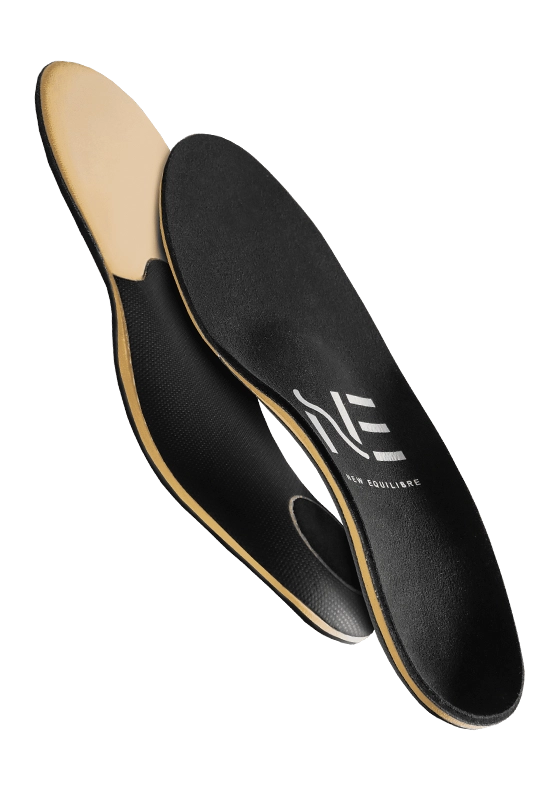
Optimize your comfort and athletic performance with New Equilibre insoles! Every sport has its insoles for optimal effectiveness. Fast delivery, available in 24h, 48h, or 72h.
The most common pathologies
A thorough understanding of foot and gait biomechanics is essential for any approach to prevention, rehabilitation, or orthopedic compensation.
At New Equilibre, we leverage this expertise to offer effective solutions that restore natural movement, provide lasting relief, and improve quality of life both in daily life and during sports.
Find our guides dedicated to the most common pathologies:

Article rédigé par Forlini Orthopedie
Spécialiste de la fabrication de semelles orthopédiques
- Plus de 35 ans d’expérience dans la prise en charge du pied (depuis 1988)
- Plus de 5000 patients accompagnés chaque année en cabinet.
- À l’origine du développement des semelles New Equilibre