
Anatomy of the foot
Structure & operation of the foot
- Published on January 10, 2020
- Update on
- By Forlini Orthopedics
The human foot is a complex anatomical structure. composed of 26 bones, around 30 joints, and more than 100 muscles, tendons, and ligaments. It forms the basis of support and plays a fundamental role in balance, movement, and shock absorption. Understanding the anatomy of the foot helps to better identify the origin of foot pain and to propose appropriate solutions to support and rebalance the foot structure.
Foot skeleton
The foot is divided into three main anatomical parts:
The hindfoot
- Talus (or Astragalus): It articulates with the tibia and fibula to form the ankle joint (talocrural joint).
- Calcaneus (or Calcaneum): From the heel, the largest bone of the foot, it supports the body's weight and receives the insertions of the Achilles tendon.
The midfoot
- Navicular (or scaphoid)
- Cuboid
- Three cuneiforms (medial, intermediate, lateral)
These bones form the arch of the foot and play a role in shock absorption and propulsion.
The forefoot
- Metatarsals (5 long axles)
- Phalanges (14 bones): Each toe has 3 (proximal, middle, distal), except for the big toe (hallux), which has 2.
The three morphological types of feet
Traditionally, three foot morphologies are distinguished, determined by the relative length of the toes. This classification has implications for footwear and the predisposition to certain pathologies.
The Egyptian foot
Present in about 50 % of the population, this is the most common foot shape. The big toe (hallux) is the longest, with the following toes progressively decreasing in length. This type of foot is more exposed to the risk of’Hallux valgus (bunion of the big toe), because the sloped shape promotes compression of the forefoot in narrow shoes.
The Greek foot
I observed in 23 % for individuals, it is characterized by a second toe that is longer than the big toe. This configuration, often associated with the ancient Greek statuary, is the easiest to fit because it naturally follows the pointed shape of most manufactured shoes. It can nevertheless encourage a Metatarsalgia (pain under the forefoot) due to increased pressure on the head of the second metatarsal.
The Roman or square foot
Regarding 27 % of the population, the Roman foot features an alignment of the first three toes, which are of substantially equal length. This morphology offers a even distribution of supports on the forefoot, which makes it a foot rarely subject to deformities related to footwear. It can, however, be associated with a flat foot due to a wider anterior support surface.


Foot joints and mobility
The foot contains about thirty joints, the main ones being:
- Subtalar joint: between the talus and calcaneus, allows for inversion and eversion movements.
- Chopard's Articulation complex articulation located between the hindfoot and the midfoot. It unites two bones of the hindfoot (the talus and calcaneus) with two bones of the midfoot (the navicular and cuboid). It allows for pronation/supination movements, contributes to the mobility of the plantar arch, and acts as a dynamic shock absorber during walking and running. It can be «locked» by certain movements (supination), strengthening the rigidity of the foot during the propulsive phase.
- Tarsometatarsal Joints (Lisfranc's Joints): ensure arch flexibility.
- Metatarsophalangeal joints important for the progression of the stride and propulsion during walking. When these joints collapse or cause pain, we speak of metatarsalgias.
Ligaments and stability
Among the many ligaments of the foot, some ensure joint stability and maintain the arch of the foot:
- Plantar calcaneonavicular ligament (or «spring ligament») medial longitudinal arch.
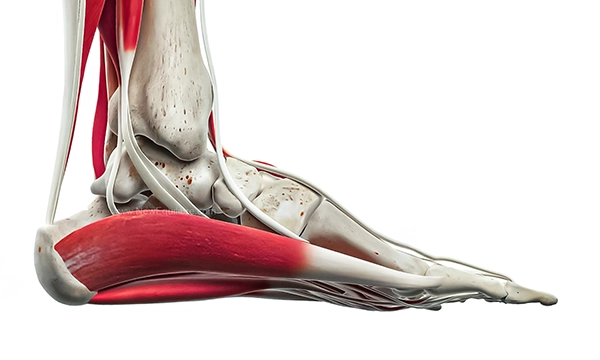
- Plantar fasciitis a tense fibrous structure extending from the calcaneus to the toes, essential in plantar fasciitis. When the aponeurosis is inflamed, it is called’Plantar fasciitis.
Main muscles and tendons of the foot
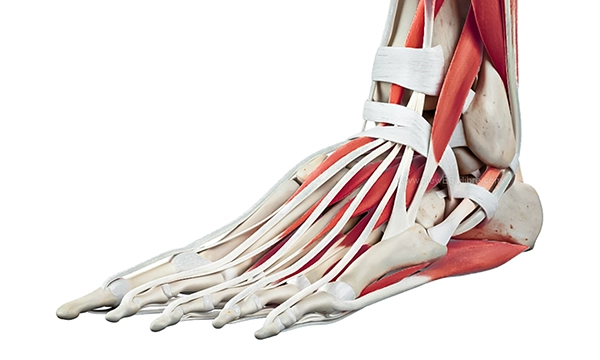
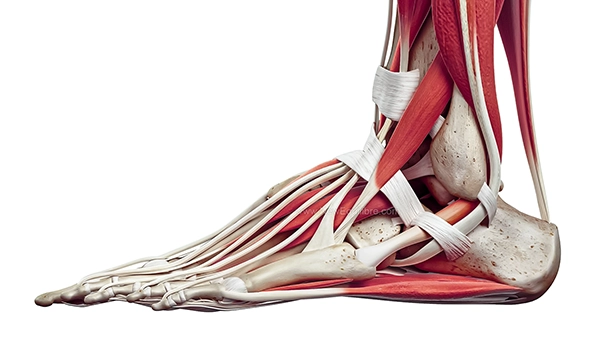
The muscles of the foot are divided into intrinsic muscles (entirely within the foot) and extrinsic muscles (originating in the leg).
Intrinsic muscles of the foot
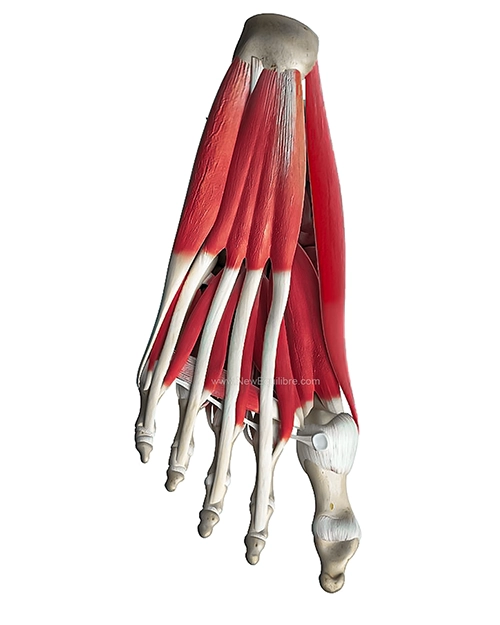
Intrinsic muscles originate and insert within the foot. They ensure the fine stability toes and participate in maintaining the plantar arches. They are grouped into four anatomical layers.
| Muscle | Main action | Innervation |
|---|---|---|
| Superficial layer (1st layer) | ||
| Abductor hallucis | Abduction of the great toe | medial plantar nerve |
| Flexor digitorum brevis muscle | Flexion of toes II to V | medial plantar nerve |
| Abductor digiti minimi muscle of foot | Abduction of the 5th toe | Lateral plantar nerve |
| 2nd layer | ||
| Quadratus plantae | Assists toe flexion | Lateral plantar nerve |
| Lumbrical muscles (×4) | Metatarsophalangeal flexion + interphalangeal extension | Medial and lateral plantar nerves |
| 3rd layer | ||
| Flexor hallucis brevis | Big toe flexion | medial plantar nerve |
| Adductor hallucis | Adduction of the great toe | Lateral plantar nerve |
| Flexor digiti minimi brevis of the foot | Flexion of the 5th toe | Lateral plantar nerve |
| 4th layer (interossei) | ||
| Dorsal interossei (x4) | Abduction of toes II to IV | Lateral plantar nerve |
| Plantar interossei (x3) | Adduction of toes III to V | Lateral plantar nerve |
Extrinsic muscles and main tendons
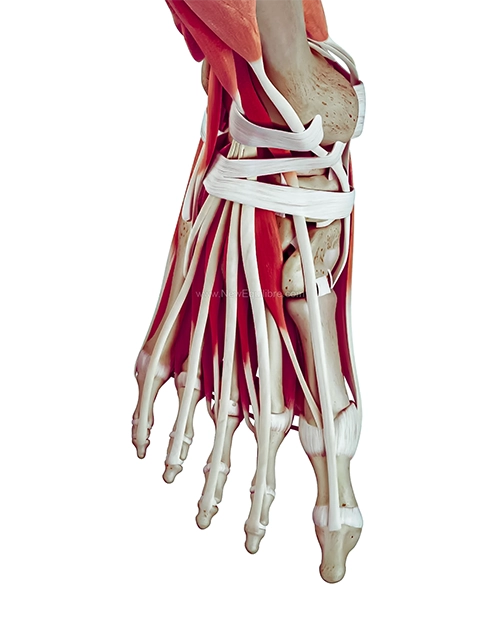
Extrinsic muscles originate in the leg and their tendons cross the ankle to insert into the foot:
- Achilles tendon (triceps surae): insertion on the calcaneus, driver of ankle plantar flexion. Essential for walking, running, and jumping.
- Posterior tibial tendon arch support and foot inversion.
- anterior tibial tendon : dorsiflexion of the ankle (lifts the foot).
- Fibular tendons (long and short): eversion of the foot and lateral stabilization of the ankle.
Vascularization and innervation
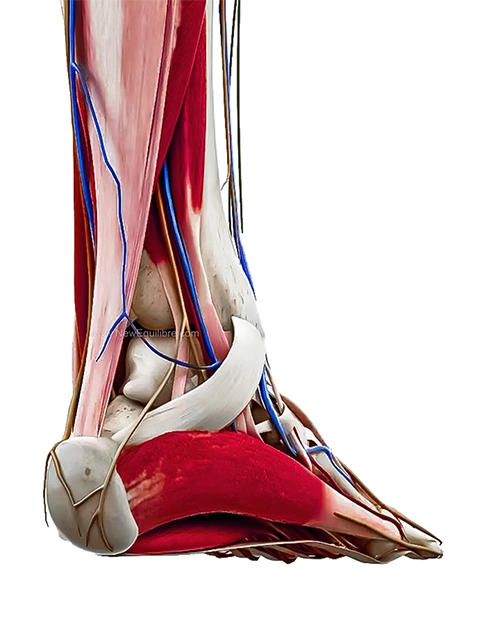
Blood supply: provided by the plantar arteries (medial and lateral arising from the posterior tibial artery.
Innervation: dependent on the tibial, deep and superficial fibular, and sural nerves.
Innervation of the foot
The foot is innervated by several nerve branches originating from the sciatic nerve, which divides at the knee:
- Tibial nerve : innervates the sole of the foot via its two terminal branches, the medial plantar nerve and lateral plantar nerve. He controls the majority of the intrinsic muscles and provides sensation to the sole of the foot. His compression in the tarsal tunnel (behind the medial malleolus) causes the tarsal tunnel syndrome, responsible for pain and tingling in the soles of the feet.
- Superficial fibular nerve innervates the dorsal aspect of the foot and the fibular muscles.
- Deep fibular nerve : innervates the extensor digitorum brevis muscle and the sensation of the first interdigital cleft (between the big toe and the second toe).
- saphenous nerve (branch of the femoral nerve): innervates the medial side of the foot.
- Sural nerve : innervates the lateral aspect of the foot and the outer border.
Vascularization
The arterial blood supply of the foot relies on two main axes:
- L’dorsal artery of the foot (dorsalis pedis), branch of the anterior tibial artery, which runs along the dorsal surface.
- The medial and lateral plantar arteries, branches of the posterior tibial artery, which supply the sole of the foot and form the deep plantar arch.
Foot arches
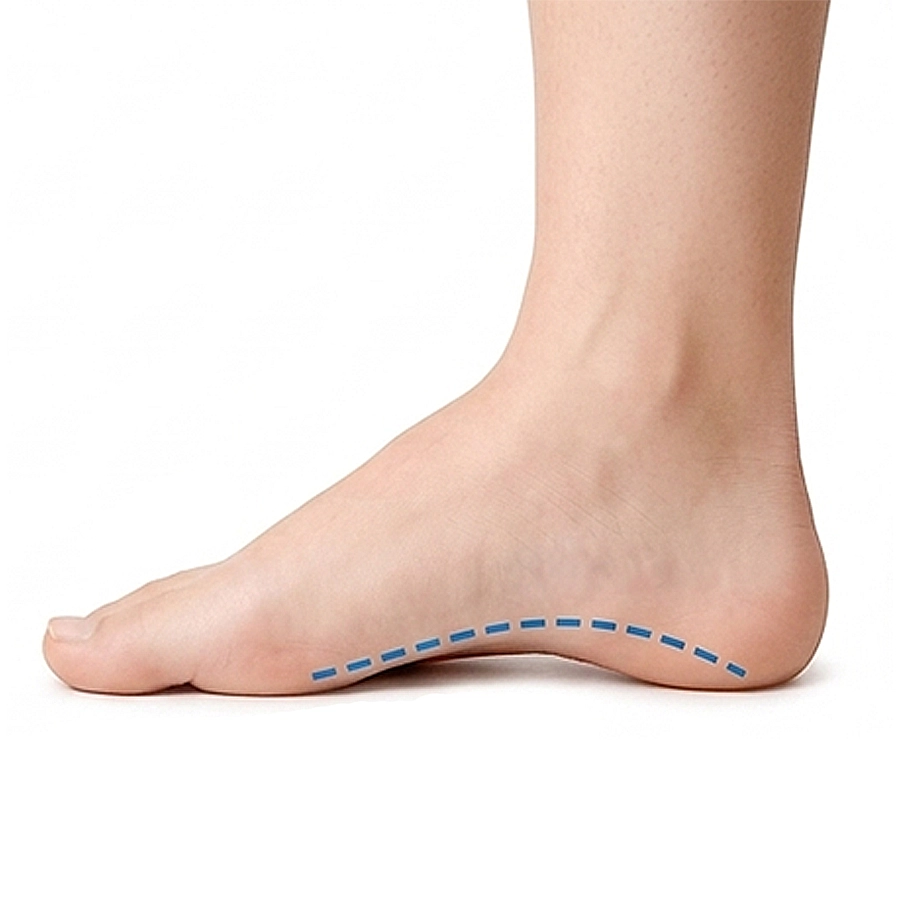
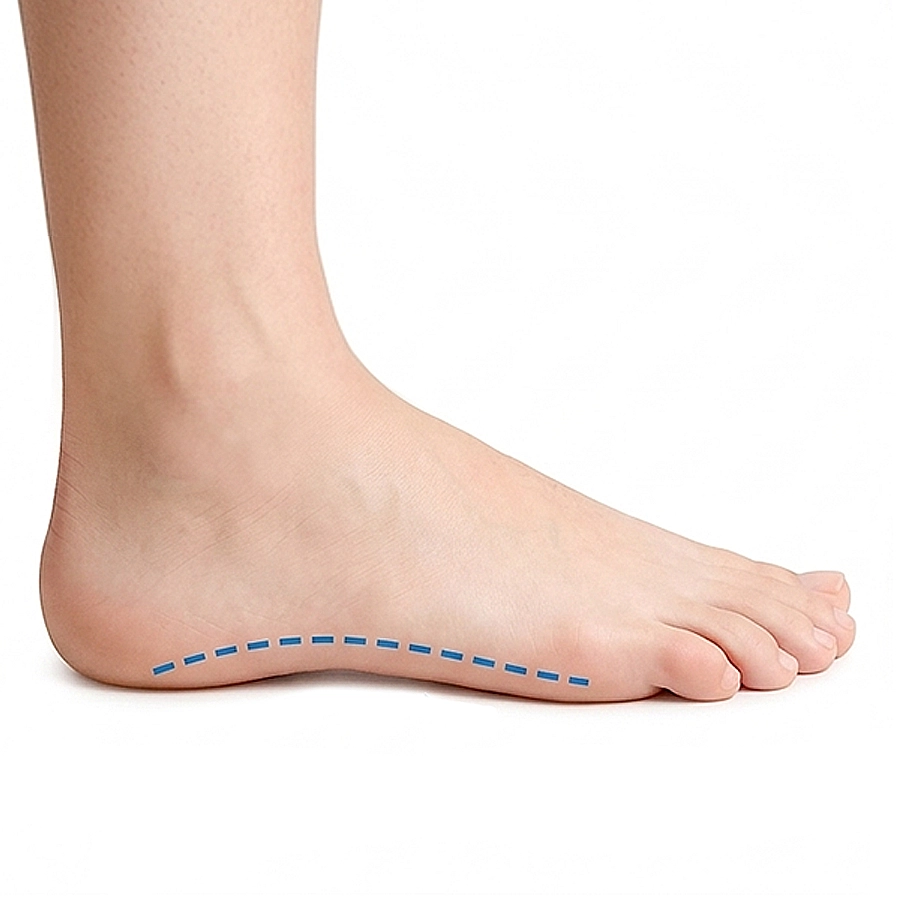
The human foot has three arches:
- Medial arch the highest, the most biomechanically important.
- Outer arch plus plate, stabilizer.
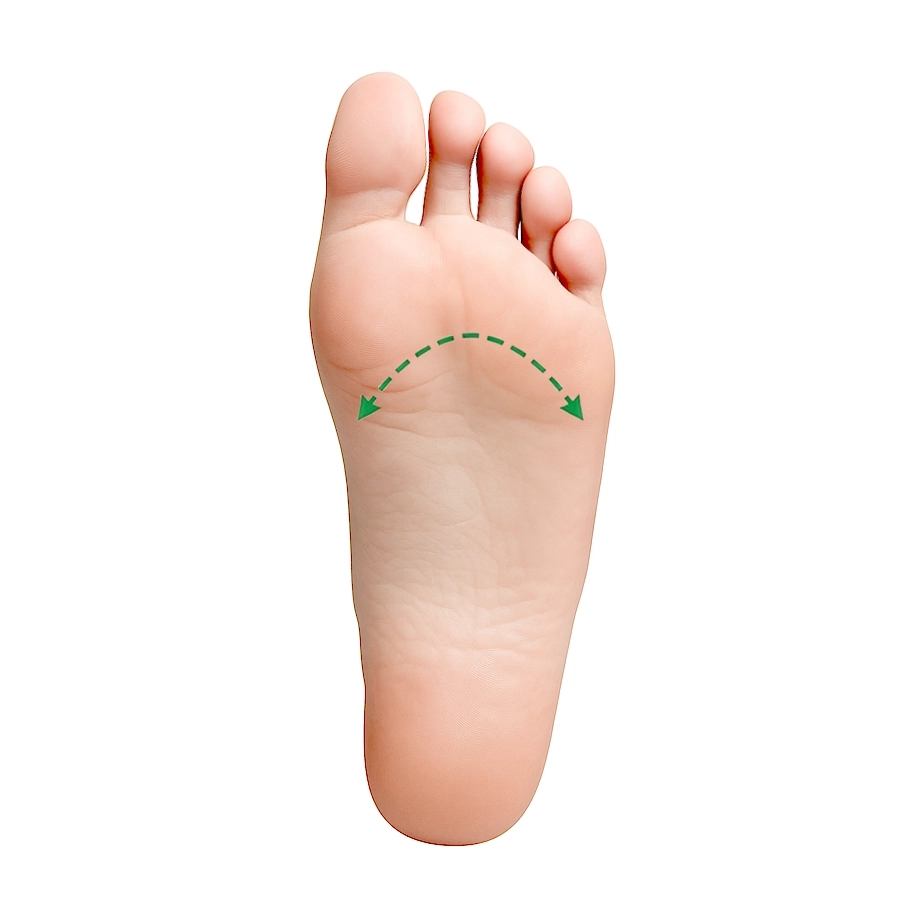
- Anterior arch passes through the metatarsal heads.
These arches allow for shock absorption, pressure redistribution, and foot propulsion during walking or running.
The plantar fascia (plantar aponeurosis)
The plantar fascia is a thick band of connective tissue that extends from the calcaneus (heel bone) to the base of the toes. A true plantar fascia stretcher, it plays an essential role in:
- The medial longitudinal arch support on foot
- L’shock absorption upon impact with the ground
- The transmission of forces between the hindfoot and the forefoot during walking
When the plantar fascia is subjected to excessive tension — for example, in the case of High-arched foot, of excessive pronation, or prolonged standing, it can become inflamed at its calcaneal insertion. This is known as plantar fasciitis (or plantar fasciitis), one of the most common causes of heel pain.
Foot biomechanics
The foot undergoes forces equivalent to several times the body's weight with each step. It functions according to a biomechanical triptych:
- Tardigrade phase Heel support
- Digitigrade Midfoot stabilization
- Digitigrade phase Forefoot propulsion
An imbalance in one of these foot strike phases can lead to:
- Pain (plantar fasciitis, metatarsalgias, Talalgias…),
- Chronic pathologies (Hallux valgus, calcaneal spur…),
- Postural problems (knees, hips, lower back...).
To go further, discover our complete guide to foot biomechanics:
Link between foot anatomy and pathologies
Orthotic insoles support the foot's pressure points and thereby rebalance the entire posture. Our orthopedists at the Forlini practice have designed New Equilibre insoles, available in just a few clicks through our online store, to offer everyone daily comfort. Their adaptive thermoformed structure molds to your foot from the very first uses to fit your morphology. Each model of New Equilibre insoles is designed with materials specific to each activity, for daily life, work, and sports.
Rebalance foot support to relieve pain
Understanding anatomical structures allows for the identification of the origin of many pathologies. Thus, we were able to design New Equilibre insoles. Made in France, our orthopedic insoles are based on our over 35 years of expertise in orthopedic practice. We offer specific models for the most common pathologies to relieve and prevent pain:
Optimize your comfort and athletic performance! Each sport has its own insoles for optimal efficiency.
FAQ - Frequently asked questions about the foot:
How many bones are in the human foot?
The adult human foot has 26 bears 7 tarsal bones (calcaneus, talus, cuboid, navicular, 3 cuneiforms), 5 metatarsals and 14 phalanges. That makes 52 bones for both feet, which represents one quarter of the 206 bones of the human body.
What are the three types of feet?
A distinction is made between Egyptian plover (longest big toe, 50 % of the population), the Greek foot (second toe longer than the big toe, 23 %) and the Roman foot or square (the first three toes aligned, 27 %). Each type has specific implications for footwear selection and health risks.
What is the plantar fascia?
plantar fascia (or plantar aponeurosis) is a thick band of connective tissue that connects the calcaneus to the base of the toes. It supports the plantar arch, absorbs shocks, and transmits forces during walking. Its inflammation is responsible for plantar fasciitis.
What is the difference between pronation and supination?
The pronation is the inward rolling of the foot during walking or running. The supination is the outward tilt. Excessive pronation can lead to plantar fasciitis or Morton's neuroma; excessive supination promotes ankle sprains and stress fractures.
What are the parts of the foot called?
The foot is divided into three regions: the’hindfoot (calcaneus, talus), the midfoot (navicular, cuboid, cuneiforms) and the’forefoot (metatarsals, phalanges). One also distinguishes the dorsal surface (top of the foot) and the plantar surface (sole of the foot).

Article written by Forlini Orthopédie
Orthotic insole manufacturing specialist
- Over 35 years of experience in foot care (since 1988)
- More than 5,000 patients supported each year in practice.
- At the origin of the development of New Equilibre insoles